
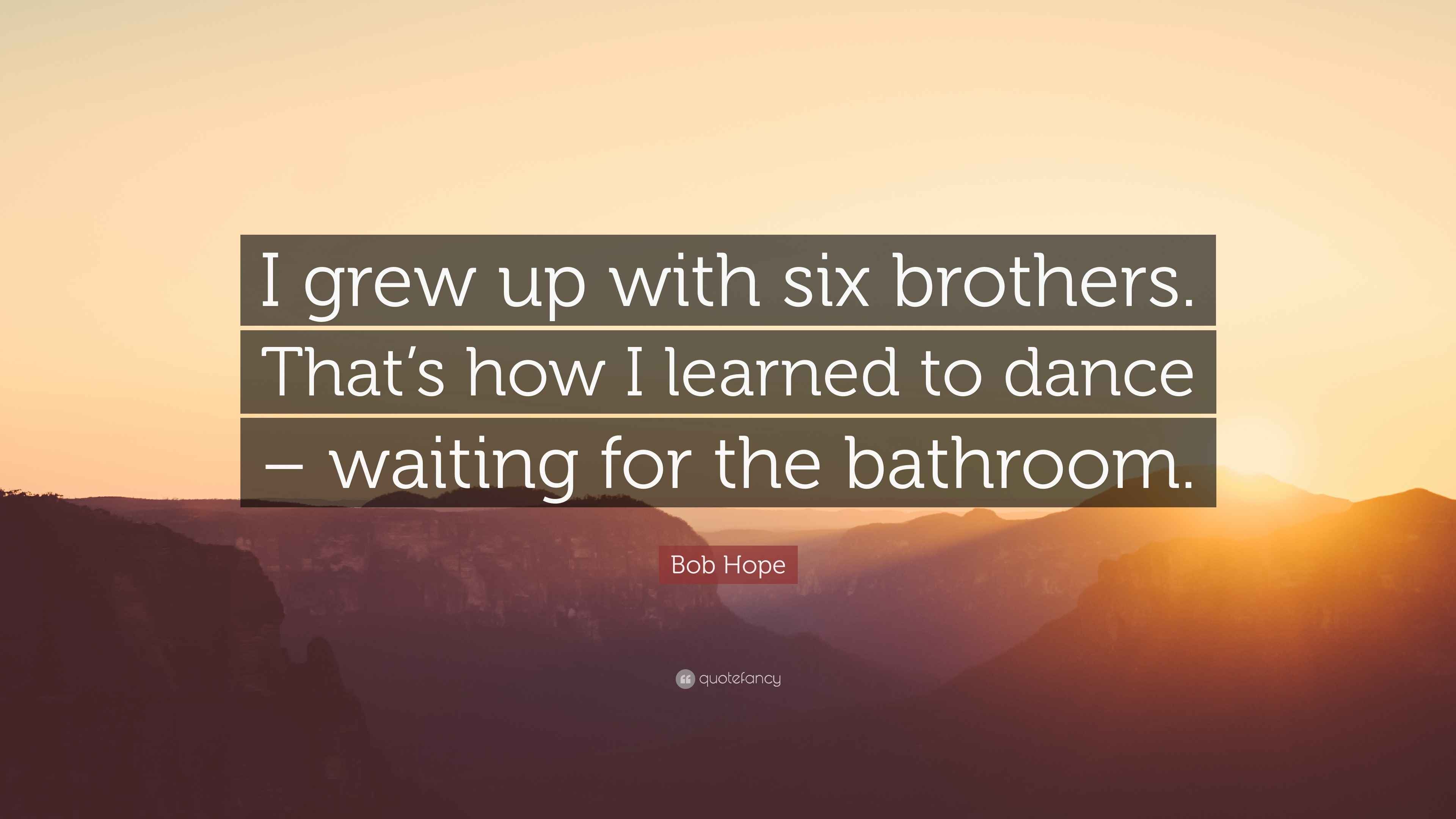
Life doesn’t hand you survival skills with a manual. Often, they’re forged in crowded bathrooms, shared bedrooms, and sibling standoffs. That’s exactly where Bob Hope acquired one of his most enduring talents—dance. Not through formal lessons, but by necessity. “I grew up with six brothers. That’s how I learned to dance—waiting,” he once quipped. This single line, delivered with his signature dry timing, packs decades of insight into sibling rivalry, personal space, emotional intelligence, and the quiet art of patience. Behind the punchline lies a masterclass in how early family dynamics shape our approach to relationships, aging, and even politics.
Let’s unpack why this quote still resonates—and what we can learn from it beyond the laugh.
The Humor in Crowded Upbringings
Humor was Bob Hope’s armor and instrument. Born in 1903 to English immigrants, he was one of seven boys in a tight-knit, financially strained household in Cleveland. Space was scarce. Privacy, nonexistent. Yet, from that chaos emerged not bitterness, but wit.
His quote, “I grew up with six brothers. That’s how I learned to dance—waiting,” turns a potential hardship into a joke with universal appeal. Who hasn’t had to wait their turn—in line, in conversation, in life?
The brilliance lies in the double meaning. “Dancing” isn’t just movement—it’s rhythm, timing, and adaptation. Waiting taught him when to step in, when to hold back. In a home where seven boys competed for attention, food, and bathroom time, those micro-moments of timing were survival.
Insight: Humor often arises from constraint. The tighter the space, the sharper the wit.
Waiting as a Life Skill
Waiting isn’t passive. In families with many children, waiting teaches emotional regulation, strategic timing, and observational intelligence. Hope didn’t just wait—he learned from waiting.
Consider: - In relationships: Knowing when to speak and when to listen often determines intimacy. Hope’s upbringing trained him in the rhythm of human interaction. - In career: His early vaudeville years were full of rejection and waiting. But he refined his act in the silence between gigs. - In conflict: You don’t survive six brothers without mastering de-escalation and timing.
Real-world example: A man raised in a large family often becomes the “peacemaker” in group settings. He reads tension before it erupts—just like avoiding a fistfight over the last pancake at breakfast.
Waiting builds resilience. It’s not about idleness; it’s about preparation. Hope didn’t just bide his time—he used it to sharpen his delivery, refine his jokes, and develop the impeccable comedic timing that defined his decades-long career.
Sibling Rivalry and Emotional Intelligence
Growing up with six brothers wasn’t just about waiting—it was a crash course in emotional intelligence.
Each brother had a role: the jock, the class clown, the quiet one, the rebel. To survive socially, Hope had to: - Read body language - Predict reactions - Deliver lines that defused tension - Know when to lead and when to follow
These are the same skills needed in romantic relationships, business negotiations, and political discourse.
Think about modern relationship dynamics. Many couples struggle because one partner interrupts, dominates conversation, or fails to read emotional cues. Hope’s household was a training ground for active listening—because if you didn’t wait for your turn, you never got to speak at all.

Common mistake: People assume emotional intelligence is innate. But for many, it’s forged in early family environments where attention is a scarce resource.
Hope used humor to navigate hierarchy and competition. In doing so, he developed a radar for hypocrisy, pretense, and power plays—skills he later weaponized in his political satire.
Aging With Grace—and a Punchline
Hope lived to 100, and his humor aged with him. As he got older, his jokes shifted from romantic escapades to creaky knees and memory lapses. But his core message remained: laugh at life, don’t fight it.
His experience with brothers taught him that control is an illusion. You can’t rush biology, time, or aging—just like you couldn’t rush your turn at the sink. So he leaned into it.
- At 80, he joked: “I’m so old, my memory is going, and so is my past.”
- On retirement: “I’ve had a perfectly wonderful evening—but this wasn’t it.”
These aren’t just jokes. They’re coping mechanisms. Aging, like growing up in a crowded home, demands adaptation. You can’t muscle your way through time. You learn to move with it—like dancing.
Modern application: Studies show that seniors who use humor to process aging report higher life satisfaction. Hope wasn’t just entertaining audiences—he was modeling emotional resilience.
Politics With a Wink
Hope’s comedic lens extended to politics. He performed for troops in every major conflict from WWII to the Gulf War and roasted every president from Truman to Clinton. Yet, he never crossed into venom.
Why? Because his humor was rooted in observation, not malice. Just like in his family, he learned to tease without destroying.
His political jokes often highlighted absurdity, not hatred. When asked about the secret to his bipartisan appeal, he said: “I’ve been bipartisan all my life. I made both my brothers and my wife laugh.”
This approach worked because it mirrored his upbringing: in a house full of strong personalities, survival meant finding common ground through humor, not division.
Compare that to today’s political climate, where social media rewards outrage over insight. Hope’s model—using comedy to expose folly without fueling fury—feels almost revolutionary.
Workflow tip: When navigating tense conversations (family, work, politics), use light humor to deflect tension—just like Hope did. A well-timed joke can disarm more effectively than a rebuttal.
The Hidden Curriculum of Large Families
Hope’s quote reveals a deeper truth: large families operate like micro-societies. They have: - Unwritten rules - Power structures - Conflict resolution norms - Shared cultural shorthand
In these environments, soft skills aren’t taught—they’re absorbed.
Skills developed in large families often include: - Negotiation (who gets the top bunk?) - Resource management (food, clothes, attention) - Conflict avoidance and resolution - Group consensus-building
These are the same competencies companies now train employees in—and Hope acquired them at the dinner table.
Contrast this with only children or small-family dynamics, where one-on-one interaction dominates. In larger families, group dynamics rule. You learn to read rooms, not just individuals.
Realistic use case: A manager raised with multiple siblings often excels at team leadership. They’re used to mediating disputes, balancing egos, and maintaining morale under pressure—just like keeping peace during a chaotic holiday meal.
Why This Quote Still Matters
In an era of curated lives, personalized playlists, and social media isolation, Bob Hope’s quote reminds us of the value of shared space and forced patience.
We don’t “dance” much anymore—we scroll, we react, we interrupt.
But Hope’s lesson endures: real rhythm comes from knowing when to move and when to wait.
His humor wasn’t just about making people laugh. It was about making life more bearable—through timing, perspective, and grace.
Today, we could use more of that. Whether dealing with traffic, a difficult coworker, or political disagreement, the ability to “dance while waiting” is a superpower.
Practical Takeaways From Hope’s Wisdom
You don’t need six brothers to apply these lessons. Here’s how to integrate them:
- Practice active waiting. Use delays—commutes, queues, loading screens—to observe, reflect, or plan. Turn idle time into insight time.
- Use humor to defuse tension. When conflict arises, ask: “How would Bob Hope joke about this?” Often, a light comment can reset a conversation.
- Improve your timing. In conversations, emails, or presentations, pause before responding. Great timing isn’t just for comedians—it’s for leaders.
- Embrace shared discomfort. Family dinners, team projects, or crowded events aren’t inconveniences. They’re training grounds for empathy and adaptability.
- Age with wit, not fear. As you get older, reframe limitations with humor. It’s not “I can’t see the menu,” it’s “I’m giving the chef a surprise.”
Hope’s life proves that resilience isn’t loud. It’s quiet, consistent, and often funny.
Closing: Dance While You Wait
Bob Hope didn’t learn to dance on a stage. He learned in the hallway, outside the bathroom, behind five older brothers. And in that cramped, chaotic space, he discovered timing, patience, and the power of a well-placed joke.
We all wait—on lines, on answers, on life to unfold. The question isn’t whether you’ll wait. It’s what you’ll do while you do.
Will you fume? Scroll? Or will you dance?
Let Hope’s legacy remind you: some of life’s best moves are learned not in spotlight, but in the queue.
FAQ
What did Bob Hope mean by “I learned to dance waiting”? He meant that growing up with six brothers taught him timing and patience—skills essential to both dancing and comedy. Waiting his turn in a crowded household trained him to read rhythms in conversation and performance.
How many brothers did Bob Hope have? Bob Hope had six brothers. He was one of seven boys in his family.
Did Bob Hope have a close relationship with his brothers? While detailed personal accounts are limited, Hope often joked about his brothers, suggesting a mix of rivalry and affection typical of large families.
How did Bob Hope’s upbringing influence his comedy? His chaotic, competitive home life sharpened his timing, observational humor, and ability to handle crowds—skills that defined his vaudeville and television success.
What life lessons can we learn from Bob Hope’s quote? Key lessons include the value of patience, emotional intelligence, using humor to cope, and mastering timing in relationships and communication.
Did Bob Hope talk about family in his performances? Yes, he frequently referenced his childhood, immigrant parents, and large family as material for jokes, grounding his humor in relatable, everyday struggles.
How can humor help in stressful family dynamics? Humor reduces tension, builds connection, and provides perspective. Like Hope, using light-heartedness can help navigate conflict and foster resilience.
What mistakes should you avoid? Avoid generic choices, weak validation, and decisions based only on marketing claims.
What is the next best step? Shortlist the most relevant options, validate them quickly, and refine from real-world results.